Advanced Vaccine Adjuvants for Next-Generation Vaccines: Global Supply, Applications & Selection Guide
QS-21 | MPLA | VQ-SAP | Gentle Quillaja | Vet-SAP | Nanoparticle Adjuvants | Liposomal Adjuvant Systems | QS-7 Fractions
Global Vaccine Adjuvant Supplier for Research, Preclinical Development & Vaccine Formulation
The development of next-generation vaccines increasingly depends not only on selecting the right antigen, but also on designing a formulation capable of generating an appropriate, durable and well-characterized immune response.
Vaccine adjuvants play an important role in this process. They can enhance or modulate immune responses to vaccine antigens and are particularly relevant for subunit, recombinant-protein and other modern vaccine platforms where the antigen alone may not generate the desired immune response. WHO and CDC describe adjuvants as vaccine components that help strengthen or improve the immune response.
For vaccine developers, pharmaceutical companies, biotechnology companies, universities, research institutes and veterinary vaccine manufacturers, choosing an appropriate adjuvant requires consideration of mechanism of action, antigen compatibility, formulation technology, immune-response profile, quality attributes, stability, scalability, regulatory strategy and supply reliability.
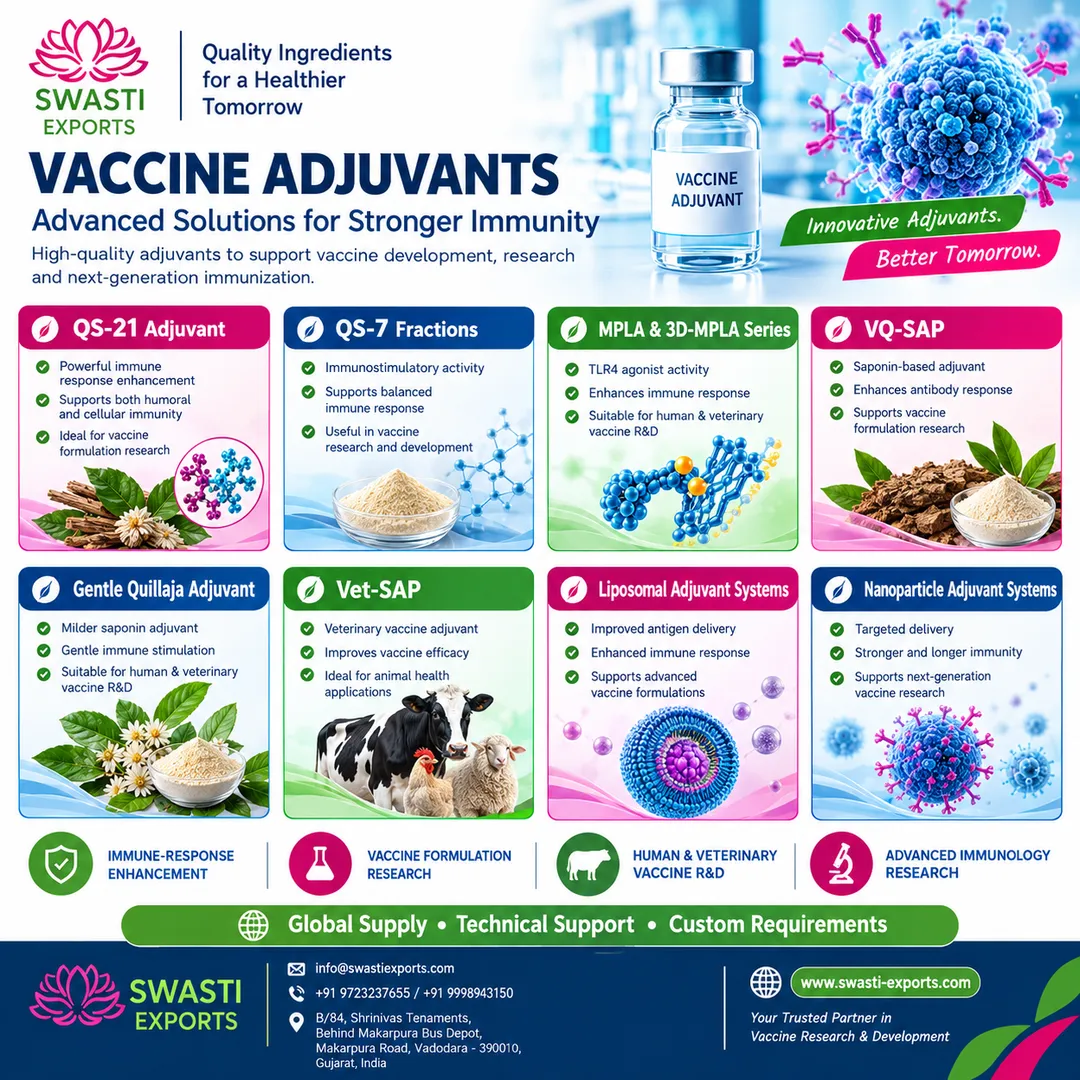
Swasti Exports provides access to a portfolio of vaccine-adjuvant technologies and research materials designed to support vaccine research, formulation development and preclinical programs.
What Is a Vaccine Adjuvant?
A vaccine adjuvant is a substance or formulation component used with an antigen to enhance or modulate the immune response.
The antigen provides the immune system with the target it needs to recognize, while the adjuvant can help shape the magnitude, quality and durability of that response.
Modern adjuvant research includes several major technology classes:
- Saponin-based adjuvants
- TLR agonists
- Liposomal systems
- Nanoparticle-based systems
- Oil-in-water emulsions
- Mineral-based adjuvants
- Combination adjuvant systems
- Antigen-delivery technologies
The choice of adjuvant should therefore be driven by the biology of the antigen and the desired immune-response profile, rather than simply selecting the most powerful immunostimulant.
Scientific reviews describe adjuvants as important tools for increasing the magnitude, breadth and durability of vaccine-induced immune responses.
Why Adjuvant Selection Matters in Vaccine Development
For vaccine developers, an adjuvant is not simply an additional ingredient.
It can influence:
1. Immune-response strength
An appropriate adjuvant can enhance the response generated against an antigen.
2. Immune-response quality
Different adjuvants can influence antibody and cellular immune responses differently.
3. Antigen dose optimization
Adjuvantation can potentially improve immunogenicity and support antigen-dose optimization during formulation development.
4. Durability
The objective may be to generate an immune response that remains effective over an extended period.
5. Delivery
Some systems can simultaneously function as immune stimulators and antigen-delivery platforms.
6. Formulation stability
The physical and chemical compatibility between antigen and adjuvant can significantly influence formulation development.
7. Development scalability
A promising laboratory formulation must ultimately be evaluated for reproducibility, characterization, manufacturing feasibility and supply continuity.
For this reason, adjuvant selection should be considered early in vaccine formulation development.
1. QS-21 Adjuvant
A Highly Studied Saponin-Based Vaccine Adjuvant
QS-21 is a highly studied saponin-based adjuvant derived from Quillaja saponaria, the Chilean soapbark tree.
It has attracted substantial interest because of its ability to stimulate both antibody-mediated and cellular immune responses. QS-21 has also been incorporated into licensed human vaccine adjuvant systems, including AS01 used in vaccines such as Shingrix and Mosquirix.
Why QS-21 is important
QS-21 is particularly relevant to research involving:
- Recombinant protein vaccines
- Subunit vaccines
- Infectious-disease vaccines
- Cancer vaccine research
- Advanced combination adjuvant systems
- Immunological research
- Next-generation vaccine formulations
Its scientific importance comes with formulation and supply challenges. Published research highlights issues including natural-source availability, hydrolytic instability and dose-related tolerability considerations.
What buyers should evaluate
When sourcing QS-21, procurement and R&D teams should evaluate:
- Purity
- Identity
- Isomer/fraction profile
- Source and manufacturing process
- Batch-to-batch consistency
- Analytical characterization
- Stability
- Packaging and storage conditions
- Intended research/application grade
- Documentation and CoA
- Supply scalability
Swasti Exports QS-21 solution: intended to support vaccine research, formulation development and advanced adjuvant-system development, subject to the specific product specification and documentation requested by the buyer.
2. MPLA Adjuvant
Monophosphoryl Lipid A for TLR4-Targeted Immune Stimulation
MPLA, or monophosphoryl lipid A, is an immunostimulatory molecule associated with activation of the TLR4 signaling pathway.
MPLA has become an important component in modern adjuvant research and combination adjuvant systems. WHO identifies monophosphoryl lipid A among important modern adjuvant technologies.
MPLA is particularly interesting for researchers seeking to investigate innate immune activation and the interaction between innate signaling and adaptive vaccine responses.
Potential research applications
- Recombinant-protein vaccines
- Subunit vaccine development
- Combination adjuvant systems
- Infectious-disease vaccine research
- Cancer vaccine research
- Immunological studies
- Preclinical formulation development
Why combination systems matter
One of the important directions in adjuvant science is the combination of complementary mechanisms.
For example, QS-21 and MPLA are components of the AS01 adjuvant system. The combination illustrates how different immunostimulatory mechanisms can be incorporated into a defined formulation strategy.
Buyer considerations
Procurement teams should assess:
Identity → Purity → Endotoxin/bioburden requirements → Analytical profile → Formulation compatibility → Stability → Documentation → Scale-up capability.
3. VQ-SAP Adjuvant
Saponin-Based Adjuvant Solution for Vaccine Research
VQ-SAP is part of Swasti Exports' saponin-based adjuvant portfolio.
Saponin adjuvants have been extensively investigated for their ability to stimulate immune responses, with Quillaja-derived materials representing one of the most studied families.
VQ-SAP is positioned for research and formulation-development applications where developers are investigating saponin-based immune stimulation.
Potential applications
- Vaccine formulation research
- Recombinant-antigen studies
- Subunit vaccine development
- Veterinary vaccine research
- Preclinical studies
- Comparative adjuvant evaluation
Why buyers may consider VQ-SAP
For development teams, a saponin-based alternative can provide another candidate for formulation screening and comparative immunogenicity studies.
However, VQ-SAP should be evaluated according to its specific technical specification rather than assuming equivalence to another commercial or regulatory product.
Recommended purchasing information
Before purchasing, buyers should request:
- Product specification
- Composition
- Purity
- Certificate of Analysis
- Source information
- Storage requirements
- Recommended handling
- Batch information
- Research/application grade
- Available quantities
4. Gentle Quillaja Adjuvant
Quillaja-Based Adjuvant for Formulation Development
Gentle Quillaja Adjuvant is positioned within the Quillaja/saponin adjuvant category for vaccine formulation research.
Quillaja-derived saponins have a long history of investigation as vaccine adjuvants. Their biological activity and formulation characteristics have made them an important area of vaccine-adjuvant research.
Potential applications
- Vaccine formulation screening
- Veterinary vaccine development
- Subunit vaccine research
- Antigen-adjuvant compatibility studies
- Preclinical formulation development
- Comparative adjuvant research
Why formulation matters
Saponins are chemically and biologically complex materials, and their performance can depend heavily on composition and formulation.
Therefore, researchers should assess:
Purity + composition + formulation + antigen compatibility + stability + intended application
rather than selecting an adjuvant based only on its generic category.
5. Vet-SAP Adjuvant
Veterinary Vaccine Adjuvant for Animal Health Research
Veterinary vaccines represent an important application area for adjuvant technology.
Saponin-based adjuvants have a long history in veterinary vaccine research, including early development and use of Quillaja-derived materials.
Vet-SAP is positioned by Swasti Exports as a veterinary-focused adjuvant solution for vaccine development and animal-health research.
Potential applications
- Livestock vaccines
- Poultry vaccines
- Companion-animal vaccines
- Aquaculture vaccine research
- Veterinary antigen formulations
- Preclinical animal vaccine studies
Why veterinary manufacturers need specialized adjuvants
Animal vaccine developers may need to balance:
- Immune-response requirements
- Animal species
- Antigen type
- Route of administration
- Formulation stability
- Production economics
- Manufacturing scale
A formulation optimized for one species or antigen should not automatically be assumed to perform identically in another.
For veterinary vaccine manufacturers
Swasti Exports can support evaluation of adjuvant candidates according to the buyer's:
species → antigen → formulation → application → quantity → specification requirements.
6. Nanoparticle Adjuvant Systems
Next-Generation Antigen Delivery and Immune-Response Technology
Nanoparticle-based vaccine technologies represent one of the most innovative areas of modern vaccine research.
Unlike conventional adjuvants that primarily focus on immune stimulation, nanoparticle systems can potentially combine antigen delivery, immune stimulation, controlled presentation and formulation functions.
Research into vaccine nanotechnologies includes systems such as liposomes, polymeric nanoparticles, lipid-based particles and other engineered delivery platforms.
Potential advantages under investigation
- Antigen delivery
- Controlled antigen presentation
- Improved formulation characteristics
- Co-delivery of antigen and immunostimulant
- Targeted delivery research
- Combination adjuvant development
- Next-generation vaccine platforms
Potential applications
- Protein vaccines
- Recombinant vaccines
- mRNA vaccine research
- Cancer vaccine research
- Infectious-disease vaccines
- Veterinary vaccines
- Personalized vaccine platforms
Importantly, “nanoparticle adjuvant” describes a broad technology category rather than one standardized formulation. Performance depends on particle composition, size, surface characteristics, antigen loading, route of administration and formulation design.
7. Liposomal Adjuvant Systems
Combining Delivery and Immunostimulation
Liposomal adjuvant systems use lipid-based structures to investigate antigen delivery and immune stimulation.
Liposomes have attracted significant attention because they can provide a structured environment for combining antigens and/or immunostimulatory molecules.
For example, published work has investigated incorporation of QS-21 into liposomal systems, with formulation approaches designed to influence its physicochemical and biological properties.
Potential applications
- Subunit vaccines
- Recombinant-protein vaccines
- Combination adjuvant systems
- Antigen-delivery research
- Cancer vaccine research
- Infectious-disease vaccine development
For buyers, the important question is not simply “Is it liposomal?”
The more important questions are:
What is the lipid composition? What is the particle size? What is the encapsulation/loading approach? How stable is the formulation? Is the antigen compatible? What analytical data are available?
8. QS-7 Saponin Fractions
Exploring Quillaja-Derived Saponin Fractions
QS-7 represents another Quillaja-derived saponin fraction investigated within the broader field of saponin-based adjuvant research.
Recent literature continues to examine different Quillaja fractions, including QS-7 and QS-21, as researchers explore structure-function relationships and alternative saponin-based adjuvant candidates.
Potential research applications
- Saponin screening
- Comparative adjuvant research
- Vaccine formulation studies
- Immunological research
- Structure-function studies
- Preclinical vaccine development
For R&D teams, QS-7 can be considered as part of a comparative adjuvant screening strategy, where multiple candidates are evaluated against the same antigen and formulation platform.
How Should Vaccine Developers Choose an Adjuvant?
There is no universal “best vaccine adjuvant.”
The best candidate depends on the antigen, vaccine platform, target population, desired immune response, administration route, formulation requirements and development stage.
A practical selection framework is:
Evaluation FactorKey Buyer QuestionAntigenWhat type of antigen is being used?Immune responseHumoral, cellular or balanced response?MechanismWhich innate pathway is being targeted?FormulationIs the adjuvant physically/chemically compatible?StabilityDoes the formulation remain stable during storage?QualityWhat analytical characterization is available?ScaleCan supply increase with development?DocumentationAre CoA and technical documents available?Regulatory strategyIs the material appropriate for the intended development stage?SupplyCan the supplier support long-term requirements?CostWhat is the total formulation cost at development/manufacturing scale?
What Should Procurement Teams Ask a Vaccine Adjuvant Supplier?
Before issuing a purchase order, global procurement and R&D teams should request:
Product information
- Product name
- Chemical/biological identity
- Composition
- Purity
- Physical form
- Concentration
- Grade
Quality documentation
- Certificate of Analysis
- Specification sheet
- Batch information
- Analytical data
- Impurity profile where applicable
- Endotoxin information where applicable
- Microbiological information where applicable
Supply information
- MOQ
- Sample availability
- Research-scale quantities
- Bulk quantities
- Lead time
- Packaging
- Storage requirements
- Shipping conditions
- Country of origin
Technical support
- Product handling
- Formulation guidance
- Compatibility information
- Stability information
- Technical documentation
- Custom requirements
Important: GMP, pharmaceutical grade, clinical grade, regulatory approval or human-use suitability should never be assumed simply because a product is described as a vaccine adjuvant. These claims should be supported by product-specific documentation.
Why Partner with Swasti Exports?
Swasti Exports supports international customers seeking vaccine-adjuvant and biopharmaceutical research materials from India.
Our portfolio is designed to support organizations involved in:
- Vaccine R&D
- Pharmaceutical development
- Biotechnology
- Contract research
- Academic research
- Veterinary vaccine development
- Antigen formulation
- Preclinical studies
- Specialty biopharmaceutical sourcing
Our approach
Global sourcing
Access to specialized vaccine and biopharmaceutical materials.
Technical orientation
Product information structured around the requirements of R&D and procurement teams.
Flexible quantities
Support for research and development requirements, subject to product availability.
Documentation
Product documentation can be provided according to the material and customer requirements.
Custom requirements
Specifications, quantities and packaging can be discussed for individual projects.
International supply
Supporting customers looking for reliable sourcing from India for international research and development programs.
The Future of Vaccine Adjuvant Technology
The next generation of vaccine development is moving toward increasingly sophisticated combinations of antigen engineering, immune modulation and delivery technology.
Emerging areas include:
- Precision adjuvants
- Combination adjuvant systems
- Nanoparticle delivery
- Liposomal formulations
- TLR-targeted immunostimulation
- Saponin-based technologies
- Self-assembling systems
- Antigen-delivery platforms
- Cancer vaccines
- Therapeutic vaccines
- Veterinary vaccines
- Personalized vaccine approaches
WHO has highlighted the continued development of novel adjuvants, including oil-based emulsions, MPLA, QS-21 and mucosal technologies, while emphasizing the importance of understanding their safety and mechanisms.
The commercial opportunity is therefore not simply about supplying an ingredient. It is about building a reliable, technically supported supply chain around vaccine innovation.
Frequently Asked Questions — Vaccine Adjuvants
What is a vaccine adjuvant?
A vaccine adjuvant is a component added to a vaccine formulation to enhance or modulate the immune response to an antigen.
What is QS-21?
QS-21 is a Quillaja-derived saponin adjuvant that has been extensively studied for its ability to stimulate humoral and cellular immune responses and is used as a component of licensed adjuvant systems.
What is MPLA?
MPLA, or monophosphoryl lipid A, is an immunostimulatory molecule associated with TLR4 signaling and is used in modern vaccine-adjuvant research and combination systems.
What is the difference between QS-21 and MPLA?
QS-21 is a saponin-derived immunostimulatory component, whereas MPLA is a lipid-based TLR4 agonist. They can also be investigated together in combination-adjuvant strategies.
What are saponin vaccine adjuvants?
Saponin adjuvants are a class of plant-derived or structurally related compounds investigated for their ability to enhance immune responses. Quillaja-derived materials such as QS-21 are among the most extensively studied.
What are nanoparticle vaccine adjuvants?
Nanoparticle adjuvants are engineered particulate systems that may combine immune stimulation with antigen-delivery functions. Their properties depend heavily on the nanoparticle composition and formulation.
Are vaccine adjuvants approved drugs?
Not necessarily. Regulatory status depends on the specific adjuvant, formulation, vaccine and intended use. An ingredient used in an approved vaccine does not mean every supplier's version is approved for clinical use.
How do I select a vaccine adjuvant supplier?
Evaluate product identity, purity, analytical documentation, batch consistency, stability, formulation compatibility, supply capacity, technical support, packaging, logistics and regulatory documentation.
Can Swasti Exports supply vaccine adjuvants internationally?
Swasti Exports is positioned to support international customers seeking vaccine-adjuvant and related biopharmaceutical materials, with specific availability, specifications, quantities and documentation confirmed on a product-by-product basis.
QS-21 supplier
QS-21 adjuvant supplier
MPLA supplier
MPLA vaccine adjuvant
saponin vaccine adjuvant
QS-7 saponin
Quillaja saponin supplier
VQ-SAP adjuvant
Gentle Quillaja adjuvant
veterinary vaccine adjuvant
Vet-SAP adjuvant
nanoparticle vaccine adjuvant
liposomal vaccine adjuvant
buy vaccine adjuvant
vaccine adjuvant bulk supplier
vaccine adjuvant research grade
vaccine adjuvant for R&D
vaccine formulation ingredients supplier
vaccine adjuvant sourcing
vaccine adjuvant supplier India
vaccine adjuvant exporter India
Vaccine Adjuvant Supplier | QS-21, MPLA, Saponin & Nanoparticle Adjuvants
Global vaccine adjuvant supplier offering QS-21, MPLA, saponin, Quillaja, veterinary and nanoparticle adjuvant solutions for vaccine R&D, formulation and preclinical development..
QS-21 Adjuvant → /products/qs-21-adjuvant
MPLA → /products/mpla-adjuvant
VQ-SAP → /products/vq-sap
Gentle Quillaja → /products/gentle-quillaja
Vet-SAP → /products/vet-sap
Nanoparticle Adjuvant → /products/nanoparticle-adjuvant
Liposomal Adjuvant → /products/liposomal-adjuvant
QS-7 → /products/qs-7-saponin
Keywords