The Future of Vaccine Adjuvants: Driving the Next Generation of Global Immunization
By Swasti Exports
Vaccination has transformed global public health, preventing millions of deaths annually and significantly reducing the burden of infectious diseases. While antigens are the cornerstone of every vaccine, adjuvants play an equally critical role by enhancing, directing, and sustaining the body's immune response. As the world enters a new era of precision medicine, personalized therapies, and emerging infectious diseases, vaccine adjuvants are becoming indispensable components of modern vaccine development.
The remarkable success of COVID-19 vaccination programs highlighted not only the importance of rapid vaccine development but also the need for advanced adjuvant technologies capable of delivering stronger, broader, and longer-lasting immunity. Today, researchers, biotechnology companies, and pharmaceutical manufacturers are investing heavily in novel adjuvant systems that can address complex pathogens, improve vaccine efficacy, and reduce antigen dosage while maintaining excellent safety profiles.
Understanding Vaccine Adjuvants
A vaccine adjuvant is a substance added to a vaccine formulation to enhance the body's immune response against a target antigen. Rather than acting as the antigen itself, an adjuvant stimulates the innate immune system, creating an environment that enables stronger activation of adaptive immunity.
The use of adjuvants offers several important advantages:
- Enhanced antibody production
- Improved T-cell responses
- Longer-lasting immunity
- Dose-sparing effects, reducing antigen requirements
- Better protection in infants, older adults, and immunocompromised individuals
- Enhanced effectiveness against complex pathogens
- Potential reduction in the number of booster doses
As vaccine technology advances, the role of adjuvants is evolving from simple immune enhancers to sophisticated immune modulators capable of tailoring immune responses for specific diseases.
The Evolution of Vaccine Adjuvant Technology
For many decades, aluminum salts (commonly referred to as alum) dominated vaccine formulations due to their safety and effectiveness. However, modern vaccines increasingly require stronger cellular immunity, broader protection, and customized immune responses that traditional adjuvants cannot always provide.
This has driven the development of advanced adjuvant platforms, including:
- Saponin-based adjuvants
- Oil-in-water emulsions
- Liposomal formulations
- Toll-like receptor (TLR) agonists
- Nanoparticle-based delivery systems
- Combination adjuvant technologies
- Synthetic immune stimulators
These innovations are expanding the possibilities for vaccines targeting infectious diseases, cancer, autoimmune disorders, and therapeutic applications.
Why Saponin-Based Adjuvants Are Gaining Global Attention
Among the most promising adjuvant technologies are Quillaja saponin-based adjuvants. Derived from the bark of Quillaja saponaria, these natural compounds have demonstrated the ability to stimulate both humoral and cellular immune responses.
Modern purified saponin formulations are widely used in research because they can:
- Generate strong antibody responses
- Promote balanced Th1 and Th2 immunity
- Enhance cytotoxic T-lymphocyte activation
- Support dose-sparing strategies
- Improve vaccine efficacy against challenging pathogens
These characteristics make saponin-based adjuvants attractive candidates for both human and veterinary vaccines, particularly where robust cellular immunity is essential.
Emerging Trends in Vaccine Adjuvant Development
The future of vaccine adjuvants is being shaped by several technological trends.
Precision Immunomodulation
Rather than simply boosting immunity, next-generation adjuvants are designed to direct specific immune pathways. This precision enables researchers to optimize vaccine performance for different diseases and patient populations.
Nanotechnology
Nanoparticle-based adjuvants are transforming vaccine delivery by improving antigen stability, targeted delivery, and controlled release. They also enhance uptake by antigen-presenting cells, increasing vaccine efficiency.
Combination Adjuvants
Combining multiple immune stimulators within a single formulation can activate complementary pathways, resulting in broader and more durable immune responses. Such systems are already influencing the design of advanced vaccines.
Artificial Intelligence in Adjuvant Discovery
Machine learning and computational biology are accelerating the discovery of novel adjuvant candidates. AI-driven screening can predict molecular interactions, optimize formulations, and reduce development timelines.
Personalized Vaccines
The emergence of personalized cancer vaccines and individualized immunotherapies is creating demand for adjuvants capable of generating highly targeted immune responses tailored to specific patients.
Applications Beyond Infectious Diseases
Although traditionally associated with infectious disease vaccines, adjuvants are now playing an increasingly important role in other therapeutic areas.
Cancer Immunotherapy
Cancer vaccines require strong cellular immunity capable of recognizing and eliminating tumor cells. Advanced adjuvants are helping improve antigen presentation and activate cytotoxic T cells, making therapeutic cancer vaccines more effective.
Veterinary Vaccines
Livestock and companion animal health remain critical to global food security and public health. Advanced adjuvants improve vaccine performance while reducing production costs and supporting large-scale immunization programs.
Emerging Infectious Diseases
Future outbreaks may involve pathogens that demand rapid vaccine development. Flexible adjuvant platforms enable researchers to adapt vaccine formulations more efficiently while maintaining strong immunogenicity.
Pandemic Preparedness
Governments and international organizations are investing in platform technologies that allow rapid response to future pandemics. Scalable, well-characterized adjuvants are expected to play a central role in these preparedness strategies.
Global Market Outlook
The global vaccine adjuvant market is experiencing sustained growth, driven by increasing vaccine research, expanding immunization programs, and rising investment in biotechnology. Demand is being fueled by:
- Growing incidence of infectious diseases
- Aging populations requiring more effective vaccines
- Expansion of therapeutic vaccine research
- Increased funding for pandemic preparedness
- Rapid advances in biotechnology and biologics manufacturing
- Rising adoption of recombinant and conjugate vaccines
- Growth of veterinary vaccine markets
North America and Europe remain major centers for vaccine innovation, while Asia-Pacific is emerging as a rapidly expanding manufacturing hub due to increased R&D investment, government support, and expanding pharmaceutical production capacity.
As biotechnology continues to evolve, vaccine manufacturers are seeking reliable partners capable of supplying high-quality adjuvants, recombinant proteins, and specialized research materials with consistent quality and dependable global logistics.
Challenges and Opportunities
Despite significant progress, several challenges remain:
- Regulatory complexity for novel adjuvants
- Manufacturing scalability
- Supply chain resilience
- Raw material sustainability
- Comprehensive safety evaluation
- Cost-effective commercial production
These challenges also represent opportunities for innovation. Companies that invest in quality systems, advanced manufacturing technologies, and collaborative research will be well positioned to support the next generation of vaccine development.
The Road Ahead
The future of vaccines will depend not only on discovering new antigens but also on developing smarter adjuvant systems capable of delivering precise, durable, and safe immune responses. Advances in nanotechnology, immunology, systems biology, and artificial intelligence will continue to reshape the field.
For pharmaceutical companies, biotechnology innovators, academic institutions, and contract development and manufacturing organizations (CDMOs), access to high-quality adjuvants will remain a strategic advantage in accelerating research and bringing new vaccines to market.
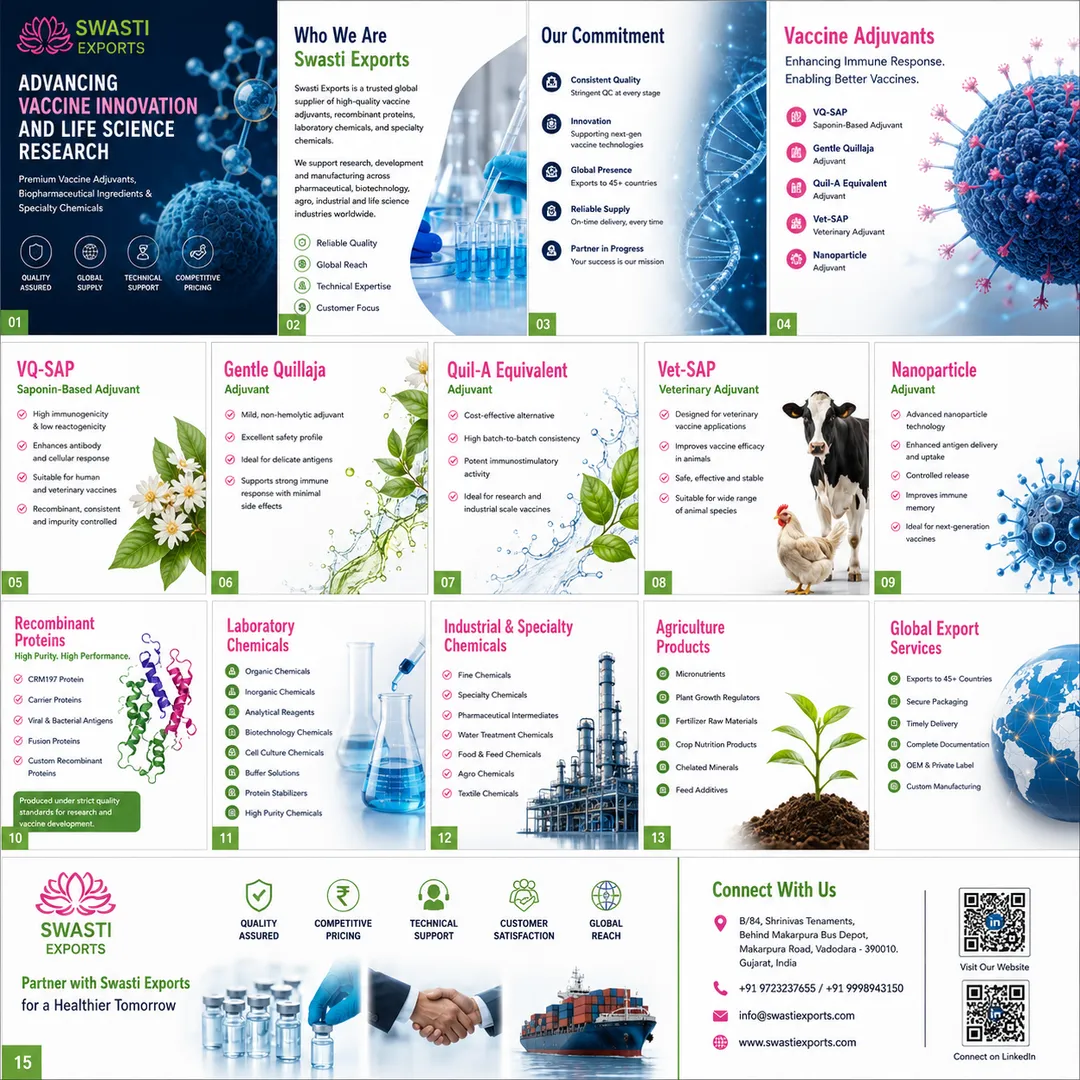
At Swasti Exports, we are committed to supporting vaccine research and manufacturing by supplying high-quality vaccine adjuvants, recombinant proteins, biopharmaceutical ingredients, and specialty chemicals to customers worldwide. Through reliable sourcing, technical support, and global export expertise, we aim to contribute to innovations that improve public health and strengthen vaccine accessibility across the globe.
Conclusion
Vaccine adjuvants have evolved from simple formulation components into sophisticated technologies that are redefining the future of immunization. Their ability to enhance immune responses, improve vaccine performance, and enable new therapeutic approaches makes them one of the most dynamic areas of modern biotechnology.
As the demand for innovative vaccines continues to grow, strategic partnerships between researchers, manufacturers, and trusted suppliers will be essential in delivering safer, more effective, and globally accessible vaccines for future generations.
About Swasti Exports
Swasti Exports is a global supplier of vaccine adjuvants, recombinant proteins, biopharmaceutical ingredients, laboratory chemicals, specialty chemicals, and agricultural products, serving pharmaceutical, biotechnology, research, and industrial organizations worldwide.
📧 Email: info@swastiexports.com
🌐 Website: www.swastiexports.com
📞 Phone: +91 9723237655 | +91 9998943150
#VaccineAdjuvants #Vaccines #Biotechnology #Immunology #LifeSciences #Biopharmaceuticals #VaccineDevelopment #DrugDiscovery #GlobalHealth #Research #Pharmaceuticals #SwastiExports
Keywords