A potassium metal quotation is incomplete if it gives only a purity figure and a per-kilogram price. You will be able to compare net metal content, protective packaging, hazard documentation, delivered cost, and supplier capability before accepting a Vadodara offer.
Key takeaways
- Confirm Potassium and CAS RN 7440-09-7 on every core document.
- Compare metal mass, purity, ampoule count, packaging, and shipment terms.
- Store ampoules under an approved inert liquid and away from moisture.
- Request the supplier’s licence, SDS, certificate of analysis, and export documents.
What exactly is being sold in the ampoule?
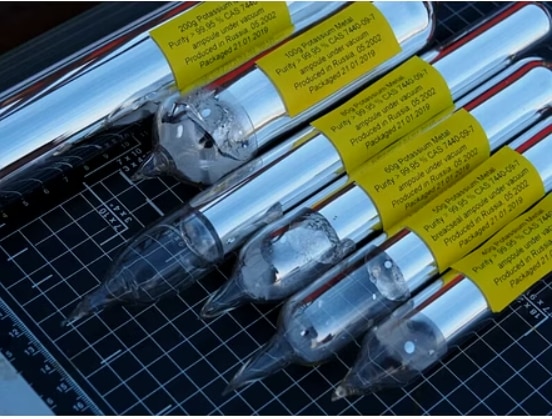
The ampoule must be identified as elemental potassium, not merely as a potassium-containing product. Require the chemical name Potassium and CAS RN 7440-09-7 together on the quotation, ampoule label, SDS, and certificate of analysis.
That CAS number excludes potassium salts, potassium hydroxide, alloys, powders, and organopotassium reagents only when the documents describe the same material consistently.
Ask for these exact confirmations:
- Product name: Potassium metal, with CAS RN 7440-09-7; reject labels such as potassium compound, potassium alloy, or potassium solution.
- Composition: assay reported for elemental K, plus the alloying elements or solvent concentration if the seller is not offering pure metal.
- Physical form: metallic pieces sealed under mineral oil or another named oxygen- and moisture-excluding medium; a dry powder is not equivalent.
- Commercial quantity: net potassium metal mass per ampoule, separated from oil, glass, overpack, and outer case weight.
Tell the potassium metal cas 7440 09 7 supplier whether it is the manufacturer, an India-based stockist, or an export intermediary, and request the matching batch number on the COA and SDS. A purity figure alone does not prove identity or traceability.
Because potassium reacts violently with water and humid air, a quotation that omits the protective medium, moisture exclusion, and dangerous-goods classification UN 2257 is incomplete.
Which ampoule specification makes two offers comparable?
Compare on net elemental potassium, not gross ampoule weight. Gross weight includes mineral oil, glass, overpack, and dangerous-goods packaging, so a cheaper kilogram quote can deliver less usable metal. For potassium metal ampoules bulk, request the same ampoule size, total net potassium, and lot structure from every supplier.
- State whether the quantity is per ampoule, pack, or case; give pieces per pack, ampoule dimensions, acceptable fill-size range, and maximum ampoules per overpack.
- Reject a catalogue purity claim as the only evidence. Require a lot-specific certificate of analysis with assay basis, lot number, filling or manufacturing date, net metal mass, and stated limits for sodium, calcium, oxygen, moisture, and other metallic impurities.
- Identify the protective medium precisely: mineral oil or another approved hydrocarbon, dry inert-gas headspace, fill level, and preservation conditions. “Sealed ampoule” alone is not enough.
| Specification | Offer 1 | Offer 2 |
|---|---|---|
| Assay | Purity value and assay basis | Purity value and assay basis |
| Net metal mass | Grams of potassium per ampoule | Grams of potassium per ampoule |
| Filling medium | Oil or inert gas; fill level | Oil or inert gas; fill level |
| Sealing | Glass seal, closure check, headspace gas | Glass seal, closure check, headspace gas |
| Pack quantity | Ampoules per pack and case | Ampoules per pack and case |
| Lot documentation | Lot COA, dates, impurity limits | Lot COA, dates, impurity limits |
| Transport protection | Secondary containment and export DG pack | Secondary containment and export DG pack |
Only after these fields match should you compare price per ampoule and per kilogram of net potassium.
What controls are needed for receiving and storing potassium metal?
Treat every ampoule as a moisture-sensitive dangerous good, not as an ordinary sealed reagent. On receipt, verify the label, lot number, net potassium mass, protective medium, seal, and outer packaging without opening it. Look for cracked glass, a lifted seal, clouded or discoloured oil, corrosion, wetness, or displaced contents.
- Move intact ampoules to a cool, dry, locked area with secondary containment, away from water, humid air, aqueous chemicals, acids, alcohols, oxidisers, heat, and ignition sources. Keep them in the supplier-specified mineral oil or other approved protective medium.
- Quarantine any leaking, broken, wet, swollen, unlabeled, or suspect ampoule. Do not open it, wipe it with water, place it in a sink, or return it to general stock; restrict access and contact your safety lead and the dangerous-goods supplier for an approved response.
- Open an intact ampoule only under a validated inert-atmosphere glovebox or equivalent dry, oxygen- and moisture-controlled procedure. A fume hood removes vapour but does not prevent potassium from igniting in humid air.
- Use completely dry, compatible tools and containers. Transfer the metal under inert gas and keep it covered by the specified protective medium whenever the procedure requires liquid protection.
- Keep acids, alcohols, oxidisers, and water out of the work area. Never improvise an extinguishing response with water or carbon dioxide; use the site’s approved Class D metal-fire agent and emergency procedure.
Record the inspection, operator, date opened, remaining mass, and new container label. Retain the original ampoule and lot records for traceability.
How should you calculate potassium metal ampoule price?
A useful potassium metal ampoule price is a landed, usable-unit cost, not a catalogue figure per kilogram. Calculate it in this order:
1. Convert every offer to net elemental potassium: total net kilograms equals ampoule count multiplied by stated potassium mass per ampoule, divided by 1,000. Divide the goods value by both ampoule count and net kilograms. Exclude glass, mineral oil, inert gas, overpack, and outer packaging from the metal denominator.
Confirm whether the quote is per ampoule, pack, or case.
2. Record the fill medium separately. Compare oil-covered potassium with dry or inert-sealed ampoules only when your handling system accepts both; the medium affects shipping weight, transfer work, cleanup, and storage. Include fill size, headspace, and maximum ampoules per dangerous-goods overpack.
3. Build the landed cost in one currency: goods value plus dangerous-goods packaging, documentation, freight, and insurance, followed by customs duty, import tax, GST, or other destination taxes. State the exchange-rate date, Incoterm, destination, and bank-charge responsibility.
4. For potassium metal ampoules bulk purchases, specify total net potassium, acceptable ampoule size, and permitted overpack count rather than piece count alone. Compare price breaks at each order tier, minimum order, mixed-lot rule, lead time, and partial-shipment charge. Many small ampoules can erase a lower unit price through added packing and freight.
What should you verify from a Vadodara supplier before payment or export?
Before paying, tie every document to the stock you will receive. Ask a potassium metal ampoule supplier in Vadodara to identify itself as manufacturer, stockist, or export intermediary, then provide photographs or an inspection record showing labels, lot number, net metal mass, protective medium, seal condition, and export packaging.
Swasti Exports, like any India-based seller, should be assessed against the same evidence rather than location alone.
Request these documents before release of funds:
- A lot-specific COA stating assay, net potassium mass, filling date, lot number, and limits for sodium, calcium, oxygen, moisture, or other metallic impurities.
- The current SDS, with Section 2 identifying hazards and Section 14 stating the transport classification, UN number, packing information, and emergency contact.
- A written damage procedure covering cracked, leaking, wet, altered, or short-delivered ampoules.
| Evidence | Check | Why it matters |
|---|---|---|
| UN 2257 arrangement | DG pack design, declaration, proposed carrier, route, and carrier acceptance | An IEC or invoice does not prove transport acceptance |
| Export file | Commercial invoice, packing list, certificate of origin if requested, shipping bill, and airway bill or bill of lading plan | Missing documents can stop customs clearance |
| Damage control | Quarantine instructions, notification deadline, replacement terms, and controlled disposal route | Never open damaged stock or place it in ordinary chemical waste |
| Final confirmation | Import-country rules and consignee permissions | Indian export compliance does not guarantee destination acceptance |
Related product
 | Metallugry Potassium Metal (K) in ampoules CAS 7440-09-07 Potassium Metal (K) in ampoules CAS 7440-09-07 is a chemical product listed under Metallugry for industrial sourcing and formulation supply across... View product → |
Frequently asked questions
What exactly should a potassium metal ampoule quotation identify?
It should identify elemental Potassium by chemical name and CAS RN 7440-09-7, not simply a potassium-containing compound.
Which details make two potassium metal ampoule offers comparable?
Compare purity, net potassium mass per ampoule, ampoule count, sealing and protective medium, outer packaging, document set, and delivery terms.
What controls are needed when receiving and storing potassium metal?
Inspect seals and labels on arrival, keep the ampoules dry and away from water and incompatible materials, and follow the SDS and site procedures for storage under the specified protective medium.
What should you verify before paying a Vadodara supplier or arranging export?
Verify the supplier’s legal identity, licence copies, SDS, certificate of analysis, batch details, packaging, dangerous-goods documents, Incoterms, and export paperwork.
Keywords