


ABOUT Swasti Exports
Exporting Quality. Building Trust.
Top Picks For You
Citric Acid Anhydrous
Citric Acid Anhydrous is a form of citric acid that contains no water of crystallization. It is widely used as an acidulant, acidity regulator, and chelating agent in food processing, beverages, pharmaceutical formulations, cosmetics, and selected industrial applications. Compared with citric acid monohydrate, the anhydrous form does not contain a stoichiometric water molecule within its crystal structure. This distinction can be important for formulations where moisture content, concentration, or processing characteristics matter. Citric Acid Anhydrous – Product Information Product name: Citric Acid Anhydrous Chemical name: Citric acid CAS number: 77-92-9 Chemical formula: C₆H₈O₇ Molecular weight: Approximately 192.12 g/mol Product category: Organic acid / Food acidulant Typical appearance: White crystalline powder or granules Key functions: Acidity regulation, flavour adjustment, and chelation Common applications: Food and beverages, pharmaceuticals, cosmetics, cleaning formulations, and selected industrial processes Supply location: Vadodara, Gujarat, India Packing: Subject to available packaging and buyer requirements Grade: To be confirmed according to the intended application Buyers should verify the product grade, purity, moisture content, applicable standards, and documentation against the actual supplier specification and Certificate of Analysis (COA). Major Applications of Citric Acid Anhydrous 1. Food Processing Industry Citric Acid Anhydrous is widely used in food manufacturing because it helps regulate acidity and contributes a clean, sour taste. Typical application areas include: Processed food products Jams, jellies, and fruit preparations Sauces and dressings Confectionery and sour candies Bakery preparations Packaged food formulations Food seasoning blends Dry food mixes The appropriate dosage depends on the product formulation, processing conditions, and applicable food regulations.
DL-Malic Acid
DL-Malic Acid is an organic acid commonly used as an acidity regulator and flavour-enhancing ingredient in food and beverage formulations. Malic acid occurs naturally in various fruits and is commercially produced for use across multiple industries. The DL form contains both D- and L-malic acid. It is valued for its clean, tart taste and its ability to contribute acidity to formulated products. DL-Malic Acid – Product Information Product name: DL-Malic Acid Chemical name: DL-Malic Acid CAS number: 617-48-1 Chemical formula: C₄H₆O₅ Molecular weight: Approximately 134.09 g/mol Product category: Organic Acid / Food Acidulant Common applications: Food and beverages, confectionery, powdered drink mixes, and other suitable formulations

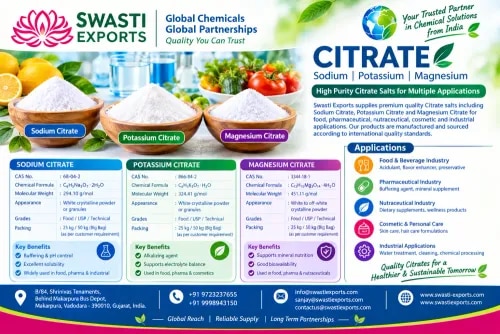
Sodium, Potassium & Magnesium Citrates High-Purity Citrate Salts Bulk Supplier & Exporter from India
Citrate Salts – Sodium Citrate, Potassium Citrate & Magnesium Citrate Comprehensive Product Description for Swasti Exports Citrate salts are salts derived from citric acid in which hydrogen ions of citric acid are replaced by mineral ions such as sodium, potassium, or magnesium. They are widely used across the food and beverage, pharmaceutical, nutraceutical, laboratory, personal-care, and industrial sectors because of their buffering, pH-control, mineral-source, stabilizing, and formulation properties. The three important products in this group are Sodium Citrate, Potassium Citrate, and Magnesium Citrate. Although all three are citrate salts, their chemical composition, mineral contribution, solubility characteristics, formulation behavior, and end uses are different. For commercial use, it is important to specify the exact chemical form, hydration state, grade, assay, and applicable regulatory standard, because citrate salts can exist in anhydrous and hydrated forms with different CAS numbers and molecular weights.
Notes, news and what we are reading


Take a closer look
A selection of photographs from our gallery. Drag to browse.