2. Why is Sulphuric Acid Important?
Sulphuric acid is often considered one of the most important bulk industrial chemicals because it is used in the manufacture of many other products.
Major applications include:
- Fertilizer manufacturing – particularly phosphoric acid and phosphate fertilizers
- Chemical manufacturing – sulfates, detergents, pigments, dyes and other chemicals
- Petroleum refining
- Metal processing
- Battery manufacturing – especially lead-acid batteries
- Mining and mineral processing
- Pharmaceutical and laboratory applications
- Water and wastewater treatment
- Chemical synthesis and pH adjustment
3. Concentrations and Grades
Sulphuric acid is commercially available in different concentrations depending on the application.
Common examples include:
- Dilute sulphuric acid – laboratory and process applications
- ~50% H₂SO₄
- ~70% H₂SO₄
- ~93–98% H₂SO₄ – concentrated/commercial acid
- 98% H₂SO₄ – commonly referred to as concentrated sulphuric acid
- Oleum – sulfur trioxide dissolved in sulphuric acid, containing more SO₃ than ordinary concentrated acid
It is also supplied in different grades, such as industrial, reagent/AR, analytical, electronic, and specialized high-purity grades.
4. Important Chemical Properties
Sulphuric acid has several important chemical characteristics.
Strong acid:
It readily dissociates in water, particularly its first proton:
H₂SO₄ → H⁺ + HSO₄⁻
Dehydrating agent:
Concentrated sulphuric acid has a strong affinity for water and can remove water from many organic materials.
Reaction with metals:
Depending on concentration and conditions, sulphuric acid can react with metals to produce sulfates and hydrogen or sulfur-containing reduction products.
Highly exothermic dilution:
Mixing concentrated sulphuric acid with water releases a large amount of heat.
Safety rule: When diluting concentrated sulphuric acid, add acid slowly to water, never water to concentrated acid, because rapid heating can cause violent boiling and splashing.
5. How is Sulphuric Acid Manufactured?
The primary industrial process is the Contact Process.
The simplified sequence is:
Sulfur → Sulfur dioxide (SO₂)
SO₂ → Sulfur trioxide (SO₃)
SO₃ → Sulphuric acid (H₂SO₄)
The key catalytic oxidation step is:
2 SO₂ + O₂ ⇌ 2 SO₃
A vanadium(V) oxide (V₂O₅) catalyst is commonly used.
Industrial SO₃ is then absorbed in concentrated sulphuric acid to form oleum, which is subsequently adjusted with water to obtain the desired acid concentration.
6. Sulphuric Acid as a Commercial Product
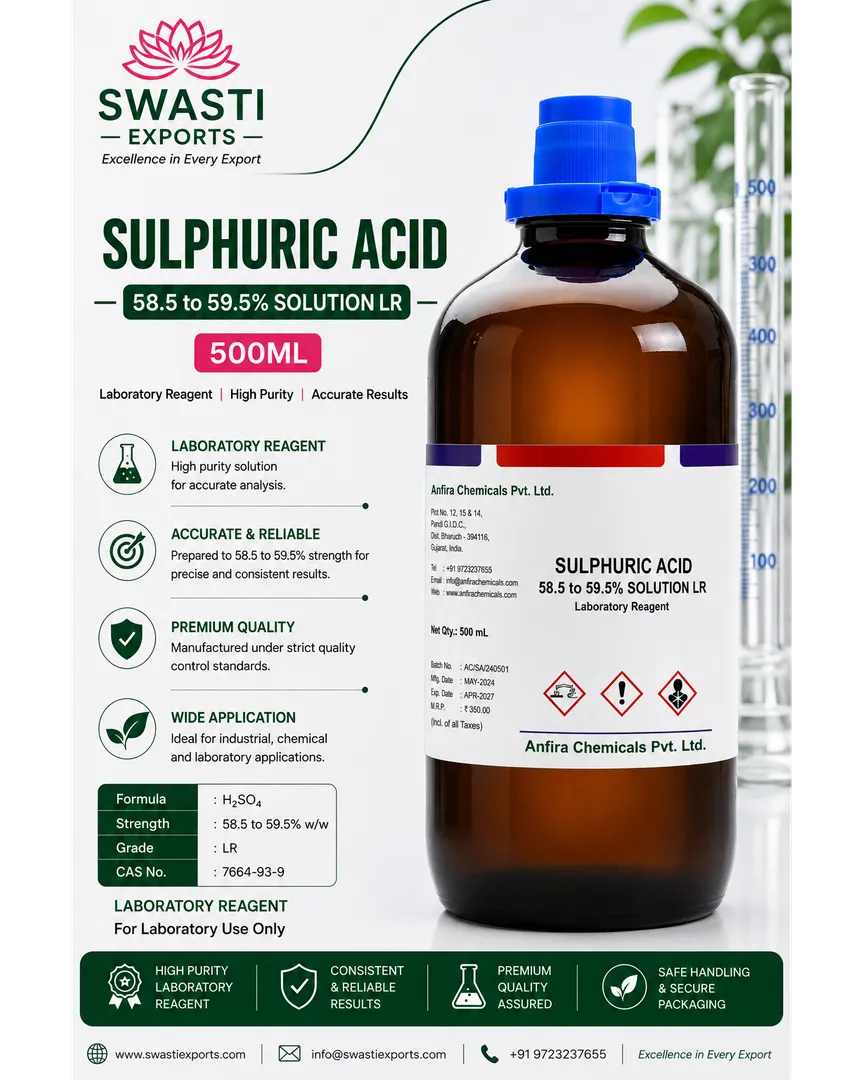
If you are considering sulphuric acid for supply through Swasti Exports, it is important to specify more than just 'Sulphuric Acid.'
A proper product specification should normally identify:
Product: Sulphuric Acid
Formula: H₂SO₄
CAS: 7664-93-9
Concentration: e.g., 98% w/w
Grade: Industrial / AR / Reagent / High Purity
Packaging: Appropriate acid-resistant packaging
COA: Certificate of Analysis available
SDS: Safety Data Sheet available
The concentration, grade, packaging size, purity/specification and intended application determine the appropriate product and commercial quotation.
Keywords