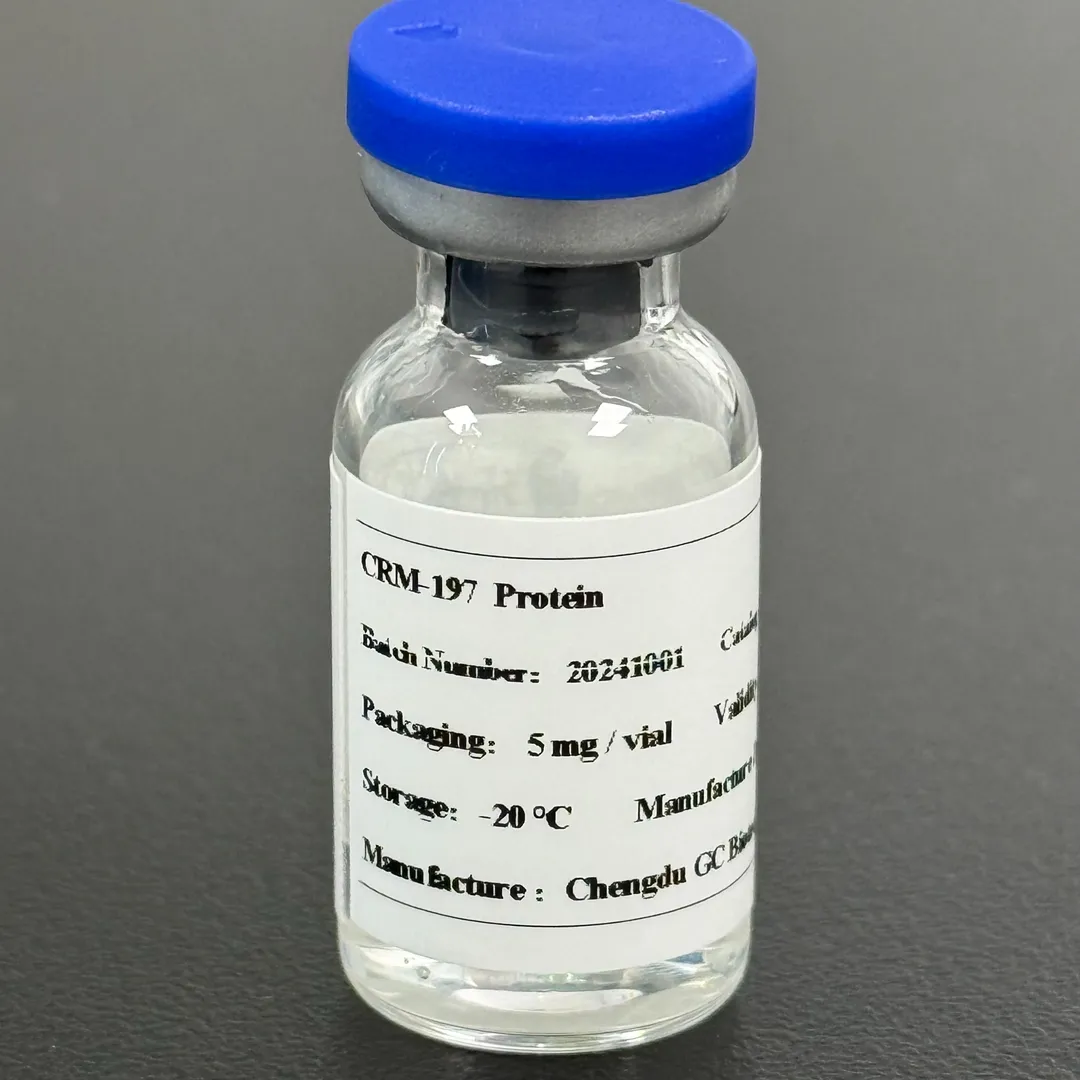
Active Ingredients:-
CRM197 is a non-toxic mutant of diphtheria toxin and one of the most commonly used carrier proteins in global vaccine development.
Product Applications:-
Suitable for polysaccharide and hapten vaccine carrier protein / cancer therapy.
Quality level
Research grade / GMP grade
CRM-197 (Cross-Reactive Material 197) is a genetically modified, non-toxic variant of diphtheria toxin that is widely used as a carrier protein in conjugate vaccines. It retains the structural features needed to provide strong T-cell help but lacks the toxic activity of native diphtheria toxin.
1. What is CRM-197?
CRM-197 is a 58.4 kDa protein consisting of approximately 535 amino acids. It originates from Corynebacterium diphtheriae and contains a well-characterized point mutation that eliminates the catalytic activity responsible for diphtheria toxin's toxicity.
The protein is particularly valuable because it can be chemically conjugated to poorly immunogenic molecules such as:
- Polysaccharides
- Oligosaccharides
- Hapten molecules
- Synthetic carbohydrate antigens
The resulting conjugate can generate a stronger, T-cell-dependent immune response.
2. How CRM-197 works as a carrier protein
The basic concept is:
Polysaccharide / antigen → chemical conjugation → CRM-197 carrier → enhanced immune recognition
Polysaccharides alone can generate relatively limited immune memory, particularly in young children. When conjugated to CRM-197, peptides derived from the carrier protein can be presented to helper T cells, providing the immune assistance needed for a stronger antibody response against the attached antigen.
This principle is used extensively in conjugate vaccine development.
3. Key technical specifications
ParameterCRM-197Product NameCRM-197 ProteinFull NameCross-Reactive Material 197Protein TypeNon-toxic mutant of diphtheria toxinProtein Size~58.4 kDaLength535 amino acidsBiological RoleCarrier protein / immunogenSourceCorynebacterium diphtheriae or recombinant production systemMajor ApplicationConjugate vaccine developmentTypical Purity≥95% or ≥98%, depending on grade/supplierResearch GradeAvailableGMP GradeAvailable from specialized manufacturersStorageTypically 2–8°C or −20°C, depending on formulationFormLyophilized powder or aqueous solutionMolecular WeightApproximately 58.4 kDa
Important: CRM-197 specifications vary significantly according to production system, formulation and intended use. A website listing should therefore use the actual supplier's CoA for exact purity, concentration, endotoxin, residual DNA/host-cell protein and storage requirements.
4. CRM-197 vs. native diphtheria toxin
The key distinction is toxicity.
Native diphtheria toxin contains an enzymatically active catalytic domain that can inhibit protein synthesis in susceptible cells.
CRM-197 contains a mutation that disrupts this catalytic activity. Consequently, CRM-197 is non-toxic under the conditions for which it is used, while retaining important antigenic and structural properties of diphtheria toxin.
This makes it useful as a carrier protein rather than as a toxin.
5. Major applications
Vaccine development
CRM-197 is one of the best-known carrier proteins used in conjugate vaccines.
It has been used with antigens including:
- Pneumococcal polysaccharides
- Haemophilus influenzae type b polysaccharides
- Meningococcal polysaccharides
- Other carbohydrate antigens
Vaccine research
CRM-197 is used for development and optimization of:
- Glycoconjugate vaccines
- Polysaccharide-protein conjugates
- Oligosaccharide vaccines
- Novel bacterial vaccines
- Experimental cancer vaccines
Cancer research
CRM-197 can also serve as a carrier protein or immunological component in experimental cancer-vaccine approaches and antigen-conjugation studies.
6. Why CRM-197 is commercially important
For vaccine manufacturers and biotechnology companies, CRM-197 is valuable because it combines:
Well-characterized protein structure + non-toxic phenotype + strong carrier-protein activity + established conjugate-vaccine history.
This makes it particularly attractive for:
- Vaccine manufacturers
- Biopharmaceutical companies
- Contract research organizations
- Vaccine-development laboratories
- Academic research institutions
- Glycoconjugate vaccine developers
Key Features:
• Non-toxic mutant of diphtheria toxin
• Approximately 58.4 kDa protein
• 535 amino acid carrier protein
• Suitable for polysaccharide and oligosaccharide conjugation
• Widely used in conjugate vaccine research
• Suitable for vaccine development and immunology research
• Available in research-grade and, subject to supplier qualification, GMP-grade formats
Applications: Conjugate vaccine development, polysaccharide-protein conjugation, vaccine carrier protein research, immunology, glycoconjugate vaccine development and experimental cancer-vaccine research.
Quality: Product specifications, purity, endotoxin level, formulation and storage conditions should be confirmed against the applicable batch Certificate of Analysis.
CRM-197 Protein — Professional Technical Specification
ParameterSpecificationProduct NameCRM-197 ProteinFull NameCross-Reactive Material 197Protein TypeNon-toxic mutant of diphtheria toxinSourceCorynebacterium diphtheriae / recombinant expression system, depending on manufacturerProtein Length535 amino acidsMolecular Weight~58.4 kDaCAS No.Not universally assigned / supplier-specificMolecular FormulaNot generally specified as a single universal formula for commercial CRM-197 proteinSequence535-aa diphtheria-toxin-derived protein containing the characteristic CRM-197 mutationStructureDiphtheria-toxin-derived three-domain protein: catalytic, translocation and receptor-binding domainsPurity≥95% or ≥98%, depending on grade and supplierEndotoxinProduct-specific; should be stated from the batch CoAAppearanceWhite to off-white lyophilized powder or clear/colorless solution, depending on formulationStorageTypically −20°C for long-term storage; 2–8°C may apply to certain formulationsApplicationVaccine carrier protein, conjugate vaccine development, immunology and vaccine researchResearch UseResearch Use Only (RUO), unless specifically supplied as GMP material
1. Protein Sequence
CRM-197 is a 535-amino-acid derivative of diphtheria toxin. The defining mutation is traditionally described as Gly52→Glu (G52E), which eliminates the native ADP-ribosyltransferase activity responsible for diphtheria toxin's toxicity while retaining the overall protein architecture needed for carrier-protein applications.
For a commercial product page, I recommend displaying:
Protein length: 535 amino acids; CRM-197 contains the characteristic G52E substitution associated with loss of diphtheria toxin catalytic activity.
Important: If you want to publish the complete 535-aa amino-acid sequence, it should be taken from the exact reference sequence used by your manufacturer because recombinant constructs can contain processing differences, tags, or additional residues.
2. Molecular Structure
CRM-197 retains the characteristic three-domain organization of diphtheria toxin:
Domain 1 — Catalytic domain (C)
Contains the region associated with the enzymatic activity of native diphtheria toxin. The CRM-197 mutation disrupts this activity.
Domain 2 — Translocation domain (T)
Participates in membrane/translocation-related functions of the native toxin.
Domain 3 — Receptor-binding domain (R)
Retains important structural/antigenic properties of the toxin and contributes to the protein's usefulness as a carrier.
For your website, the structure should therefore be described as:
“Three-domain diphtheria-toxin-derived carrier protein with a defined G52E mutation.”
3. Purity Specification
For a research-grade CRM-197 listing, a commercially realistic specification would be:
TestSpecificationAppearanceWhite/off-white lyophilized powder or solutionIdentityConforms to CRM-197 identityPurity≥95% or ≥98%Molecular weight~58.4 kDaSDS-PAGEConsistent with expected molecular sizeSEC-HPLCUsed to evaluate aggregationProtein concentrationAs stated on CoAEndotoxinBatch-specificpHProduct/formulation-specificSterilityApplicable to GMP/sterile materialResidual DNAApplicable to recombinant/GMP productionHost-cell proteinsApplicable to recombinant/GMP productionStorage−20°C or manufacturer specification
4. Endotoxin
This is particularly important if you intend to sell CRM-197 for vaccine or cell-based research.
Do not put a generic value such as “<1 EU/mg” on your website unless your supplier's CoA actually supports it.
A safer website specification is:
Endotoxin: ≤ specified limit according to product grade and batch Certificate of Analysis.
For a GMP-grade CRM-197 product, the supplier should provide a validated endotoxin specification and batch result.
5. Molecular Formula and CAS Number
For proteins, these fields are handled differently from small molecules.
CAS No.: There isn't a universally appropriate CAS number that should automatically be assigned to every commercial CRM-197 preparation.
Molecular formula: A 535-aa protein does have an elemental composition based on its exact sequence, but commercial CRM-197 can differ according to expression system, processing, tags, terminal residues and formulation. Therefore, using a formula copied from an unrelated CRM-197 supplier can be misleading.
For your catalogue, I recommend:
CAS No.: Supplier/construct specific
Molecular Formula: Not routinely specified for commercial protein preparations
This is more technically defensible than publishing an incorrect CAS/formula.
- CRM-197 protein
- CRM197 protein
- CRM 197
- CRM-197 carrier protein
- Cross-Reactive Material 197
- CRM197 vaccine carrier
- CRM197 carrier protein
- Diphtheria toxin mutant
- Non-toxic diphtheria toxin mutant
- Recombinant CRM197
CRM197 vaccine carrier protein
CRM197 conjugation
CRM197 conjugate vaccine
CRM197 protein carrier
CRM197 recombinant protein
CRM197 antigen carrier
CRM197 polysaccharide conjugation
CRM197 oligosaccharide conjugation
CRM197 hapten carrier
CRM197 immunology
CRM197 vaccine research
CRM197 glycoconjugate
CRM197 protein research
G52E diphtheria toxin mutant
diphtheria toxin CRM197
58.4 kDa CRM197 protein
535 amino acid CRM197
- vaccine carrier protein
- conjugate vaccine carrier
- glycoconjugate vaccine development
- polysaccharide vaccine development
- bacterial vaccine development
- pneumococcal vaccine research
- meningococcal vaccine research
- Hib vaccine research
- vaccine antigen conjugation
- protein-polysaccharide conjugation
- immunogenic carrier protein
CRM197 protein supplier
CRM197 protein manufacturer
CRM197 protein exporter
CRM197 protein distributor
CRM197 protein India
CRM197 protein supplier India
recombinant CRM197 supplier
CRM197 research grade
CRM197 GMP grade
CRM197 vaccine grade
CRM197 bulk supplier
CRM197 protein wholesale
CRM197 carrier protein supplier
CRM197 conjugation grade
high purity CRM197 protein
high purity CRM197 protein supplier
recombinant CRM197 carrier protein
CRM197 protein for vaccine development
CRM197 protein for conjugate vaccines
CRM197 protein for polysaccharide conjugation
CRM197 carrier protein for vaccine research
CRM197 protein for glycoconjugate vaccine development
CRM197 non-toxic diphtheria toxin mutant
CRM197 535 amino acid carrier protein
CRM197 58.4 kDa protein
research grade CRM197 protein supplier
GMP grade CRM197 carrier protein
CRM197 protein for pharmaceutical research
CRM-197 Protein — High-Purity Vaccine Carrier Protein
CRM-197 (Cross-Reactive Material 197) is a well-characterized, non-toxic mutant of diphtheria toxin widely used as a carrier protein in conjugate vaccine development and advanced immunological research.
CRM-197 is a 535-amino-acid diphtheria-toxin-derived protein with a molecular mass of approximately 58.4 kDa. The characteristic G52E mutation eliminates the native catalytic activity associated with diphtheria toxin while retaining important structural and immunological characteristics that make CRM-197 highly suitable as a carrier protein.
CRM-197 is extensively utilized for conjugation with polysaccharides, oligosaccharides, haptens and other antigens to support the development of glycoconjugate and conjugate vaccine platforms. It is also valuable for research in immunology, vaccine antigen design and protein-carbohydrate conjugation.
Key Features
• 535-amino-acid diphtheria-toxin-derived protein
• Approximately 58.4 kDa molecular mass
• Characteristic G52E mutation
• Non-toxic carrier-protein platform
• Suitable for polysaccharide and oligosaccharide conjugation
• Widely used in conjugate vaccine research
• Suitable for vaccine and immunology research
• Research-grade and specialized GMP-grade formats may be available
Applications
Conjugate vaccine development, glycoconjugate vaccine research, polysaccharide-protein conjugation, oligosaccharide conjugation, hapten-carrier studies, vaccine antigen development and immunological research.
Quality Parameters
Purity, endotoxin, protein concentration, aggregation, identity and other quality attributes are determined according to the applicable product grade and batch Certificate of Analysis.
Storage
Store according to the manufacturer's validated conditions. Long-term storage is commonly at −20°C for lyophilized research-grade material.
Product Classification
Research Use Only (RUO), unless supplied under an applicable GMP or other regulated grade.
Keywords