
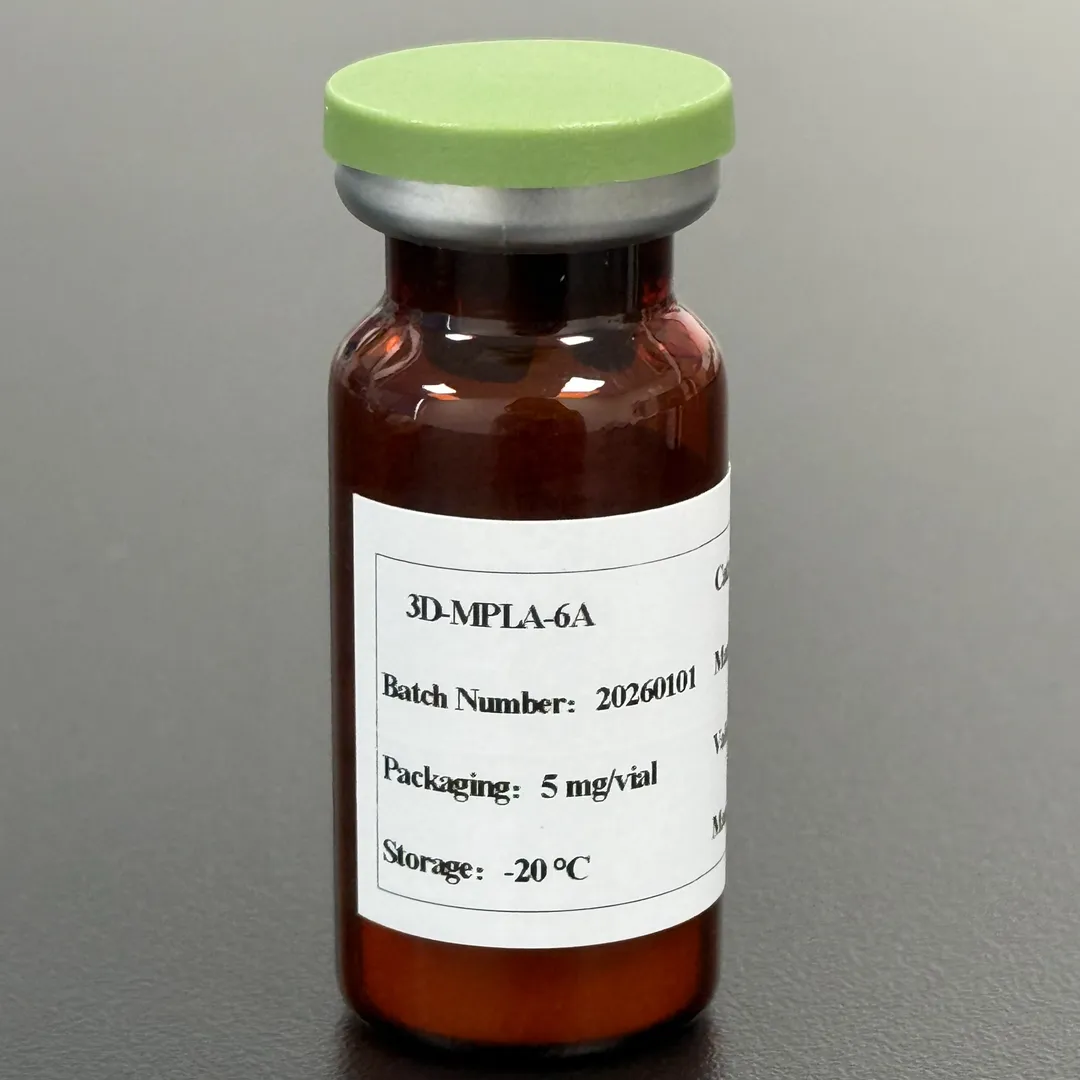
Active Ingredients:-
Full Name: 3-O-desacyl-4'-monophosphoryl lipid A, Hexa-acylated Form.
Origin: Derived from the Lipopolysaccharide (LPS) of Salmonella minnesota R595
Molecular Structure: Features a distinct framework with six fatty acid chains (Hexa-acyl)
Product Applications:-
As the most bioactively potent and thoroughly characterized member of the Monophosphoryl Lipid A family, it stands as the 'Gold Standard' adjuvant in modern vaccinology and immunotherapy research.Functioning as a robust TLR4 agonist, it provides the essential molecular blueprint for triggering precise and powerful immune activation.
Quality level:-
Research grade
3D-MPLA-6A is a fully synthetic, structurally defined monophosphoryl hexa-acyl lipid A derivative. It is also commonly described as 3D-(6-acyl) PHAD®, 3D-6A-MPLA, or 3-deacyl-6-acyl phosphorylated hexa-acyl disaccharide (3D-6A-PHAD).
Unlike 3D-MPLA-3A, -4A and -5A, the 6A designation refers to the hexa-acyl configuration, meaning the molecule contains six fatty-acyl chains. It is structurally close to naturally occurring MPLA and is widely investigated as a defined TLR4/MD-2 immunostimulatory compound.
What does “3D-MPLA-6A” mean?
The name can be understood as:
- 3D = 3-deacylated at the 3-position of the lipid A backbone
- MPLA = monophosphoryl lipid A
- 6A = six-acyl / hexa-acyl configuration
The compound retains the characteristic glucosamine disaccharide lipid-A backbone, one phosphate group, and six lipid chains. This defined structure makes it useful for controlled research compared with heterogeneous naturally derived MPLA preparations.
Biological significance
3D-MPLA-6A is designed to interact with the TLR4/MD-2 receptor complex, which is an important component of innate immune recognition. Synthetic 3D-(6-acyl)-PHAD has been investigated in vaccine-adjuvant and innate-immunity research, including studies comparing its activity with MPLA and other phosphorylated hexa-acyl disaccharides.
A particularly important distinction is that 3D-6A-MPLA is not simply another generic “MPLA.” It is a defined synthetic molecular species with a specific acylation pattern. Research literature has specifically compared 3D-PHAD and 3D-(6-acyl)-PHAD as separate structures.
Confirmed chemical identity
For the free-acid form, the FDA GSRS record gives:
- Name: 3D-6A-MPLA free acid
- Molecular formula: C₉₆H₁₈₁N₂O₂₁P
- Molecular weight: 1,730.44 g/mol
- Charge: 0
- Stereochemistry: Absolute, with 13/13 defined stereocenters
However, a commonly commercially supplied form of 3D-(6-acyl) PHAD® is the ammonium salt, for which PubChem lists:
- CAS: 2250122-35-9
- Formula: C₉₆H₁₈₄N₃O₂₁P
- Molecular weight: 1,747.5 g/mol
This distinction is very important for your product catalogue. The 1,730.44 g/mol value is for the free acid, whereas 1,747.5 g/mol corresponds to the ammonium salt.
Commercial research-grade specifications
An Avanti Polar Lipids CoA for 3D-(6-acyl) PHAD®, catalog 699855P reports a white solid powder, storage at −20°C, molecular weight 1,747.469, formula C₉₆H₁₈₄N₃O₂₁P, and an HPLC-ELSD specification of NLT 99% AUC; the cited lot tested at 100% AUC.
Main applications
3D-MPLA-6A is relevant to:
- Vaccine adjuvant research
- TLR4/MD-2 signaling studies
- Innate immune-response research
- Immunology research
- Subunit vaccine development
- Liposomal and nanoparticle adjuvant formulations
- Structure–activity relationship studies
- Synthetic MPLA research
- Preclinical vaccine research
- Investigation of controlled TLR4 agonism
- Combination-adjuvant systems
For example, 3D-6A-PHAD has been incorporated into experimental liposomal vaccine formulations alongside other adjuvant components.
In simple terms
3D-MPLA-6A is a highly defined synthetic lipid-A-type immunostimulant with six fatty-acyl chains and one phosphate group. Its principal research importance comes from its ability to engage the TLR4/MD-2 innate immune pathway, making it valuable for the development and mechanistic study of vaccine adjuvants and immunostimulatory formulations.
- 3D-MPLA-6A
- 3D MPLA 6A
- 3D-6A-MPLA
- 3D-(6-acyl) PHAD
- 3D-6A-PHAD
- 3-Deacyl-6-acyl Monophosphoryl Lipid A
- Monophosphoryl Lipid A
- MPLA
- Hexa-acyl MPLA
- Synthetic MPLA
- Lipid A derivative
TLR4 agonist
TLR4/MD-2 agonist
TLR4 immunostimulant
TLR4 signaling research
Innate immune activation
Innate immunity research
Lipid A analogue
Synthetic lipid A
Phosphorylated hexa-acyl disaccharide
Immunostimulatory glycolipid
Vaccine adjuvant research
Immunology research reagent
- 3D-MPLA-6A supplier
- 3D-MPLA-6A manufacturer
- 3D-MPLA-6A exporter
- 3D-MPLA-6A distributor
- 3D-MPLA-6A bulk supplier
- 3D-MPLA-6A research grade
- 3D-(6-acyl) PHAD supplier
- 3D-6A-PHAD supplier
- MPLA supplier
- Synthetic MPLA supplier
- TLR4 agonist supplier
- Vaccine adjuvant supplier
- Lipid A derivative supplier
- 3D-MPLA-6A CAS 2250122-35-9
- 3D-MPLA-6A vaccine adjuvant
- 3D-MPLA-6A TLR4 agonist
- 3D-(6-acyl) PHAD research reagent
- synthetic hexa-acyl MPLA
- monophosphoryl lipid A for vaccine research
- TLR4 MD-2 pathway research compound
- lipid A analogue for immunology research
- synthetic lipid A vaccine adjuvant
- high purity 3D-MPLA-6A
- research grade 3D-MPLA-6A
- 3D-MPLA-6A India supplier
- 3D-MPLA-6A global exporter
Keywords